
Physiotherapy app ecosystem
Case study

Client: Sunnybrook Hospital / Halterix
Company: mindsea
Position: Sr Product Designer
Duration (design to delivery): 11 months
Product type: Android
A crumb of context
Background:
I effectively lead the design and development of an extensive physiotherapy app ecosystem, encompassing mobile, tablet, a watch app, and a user-friendly web portal. In partnership with Sunnybrook Hospital, our objective was to elevate patient experiences and enhance recovery outcomes by facilitating at-home exercise completion.
Studies indicate that patient adherence to home exercises substantially accelerates recovery and reduces the risk of re-injury. Leveraging AI and machine learning technology, we harnessed the capabilities of the accelerometer and gyroscope within a smartwatch to track movements and offer valuable feedback to both the patient and the practitioner.
The Challenge:
Developing a cross-platform system that empowered both patients and physiotherapists, promoting engagement and expediting the recovery process.
Why It Matters:
Through the incorporation of gamification tactics, we successfully encouraged regular app usage. My contributions highlight my skills in collaboration, client management, UI design, and user research.

The Blueprint process
Using mindsea’s ‘Blueprint’ approach, I streamlined the progression from client ideas, background details, and technical constraints into comprehensive app concepts, including estimated timelines and costs, usually within a 6-week timeframe. For more complex projects like this, we extended the process to 12 weeks, concurrently designing both phone and tablet apps.
-
After prepping with Discovery materials and competitive analysis, we hosted an all-day kickoff workshop to accomplish the following:
Crafted a clear, concise mission statement to guide our efforts.
Identified and prioritized the client's core objectives.
Created a competitive analysis for insights and inspiration.
Developed low fidelity personas to keep users at the forefront.
Visualized user experiences through journey mapping to understand and optimize the product's flow.
Outlined scope and defined constraints.
Established a feature roadmap to guide development milestones.
-
Prior to initiating wireframing, I established the information architecture for both apps, validating it with our lead developer and client to ensure feasibility and alignment.
-
I generated mid-fidelity wireframes to establish the design direction for both mobile phone and tablet apps. This phase involved rapid turnarounds, with two client and internal reviews per week and three rounds of revision per app.
The objective of these wireframes was to create a foundation robust enough for user testing and to map out the flows, interactions, and hierarchy for the final visual design.Throughout this process, I collaborated with developers to ensure technical feasibility and maintained an active feedback loop with clients for alignment.
-
User feedback is integral to this process, and recognizing its significance, I conducted usability testing between rounds 2 and 3 of wireframe revision using the following steps:
Constructed wireframe prototypes for usability evaluation.
Created the script, flow, and objectives for testing.
Conducted 2 moderated tests with 5-7 users (former physiotherapy patients and current practitioners) per test.
Synthesized and analyzed user feedback into 2 findings reports to share with clients.
-
Once the wireframes received approval, the transition to visual design and branding began. As Halterix lacked established branding beyond a logo concept, I initiated the branding deliverables from scratch to create a cohesive and visually appealing design with these steps:
Defined typography for a coherent design language.
Established a style guide for consistency.
Selected a harmonious colour palette.
Designed interactive elements.
Established a consistent tone and voice for user interactions.
After obtaining approval for the branding deliverables, I incorporated that styling into the wireframes:
Enhanced wireframes with the polished UI layer
Packaged a complete set of UI assets for client handoff.
-
The last step in this process involves providing our client with an estimate of the time and resources required to build and launch the idea. This detailed document enhances transparency and fosters trust in our pricing.
Created line items for all project components and features.
Estimated time to complete, including development and quality assurance.
Constraints and considerations
Technological
The data collected by the smartwatch needed synthesis and transmission to both patient and practitioner apps, resulting in noticeable delays for users.
The limitation of relying solely on a smartwatch for data collection restricted the variety of exercises we could include.
Users
Patients, potentially from an older demographic, might face challenges in setting up a complex, multi-device system.
Practitioners, constrained by limited time during appointments, necessitated an efficient tablet app.
Additionally, the lending of hardware was required since not all patients owned smartwatches.
Medical
For use in a clinical trial with Sunnybrook Hospital in Toronto, all products underwent a medical ethics review.
Ensuring the protection of patient data mandated compliance with HIPAA and PIPEDA standards.
See the Blueprint process
👀 👀 👀
See the Blueprint process 👀 👀 👀

Tablet app information architecture
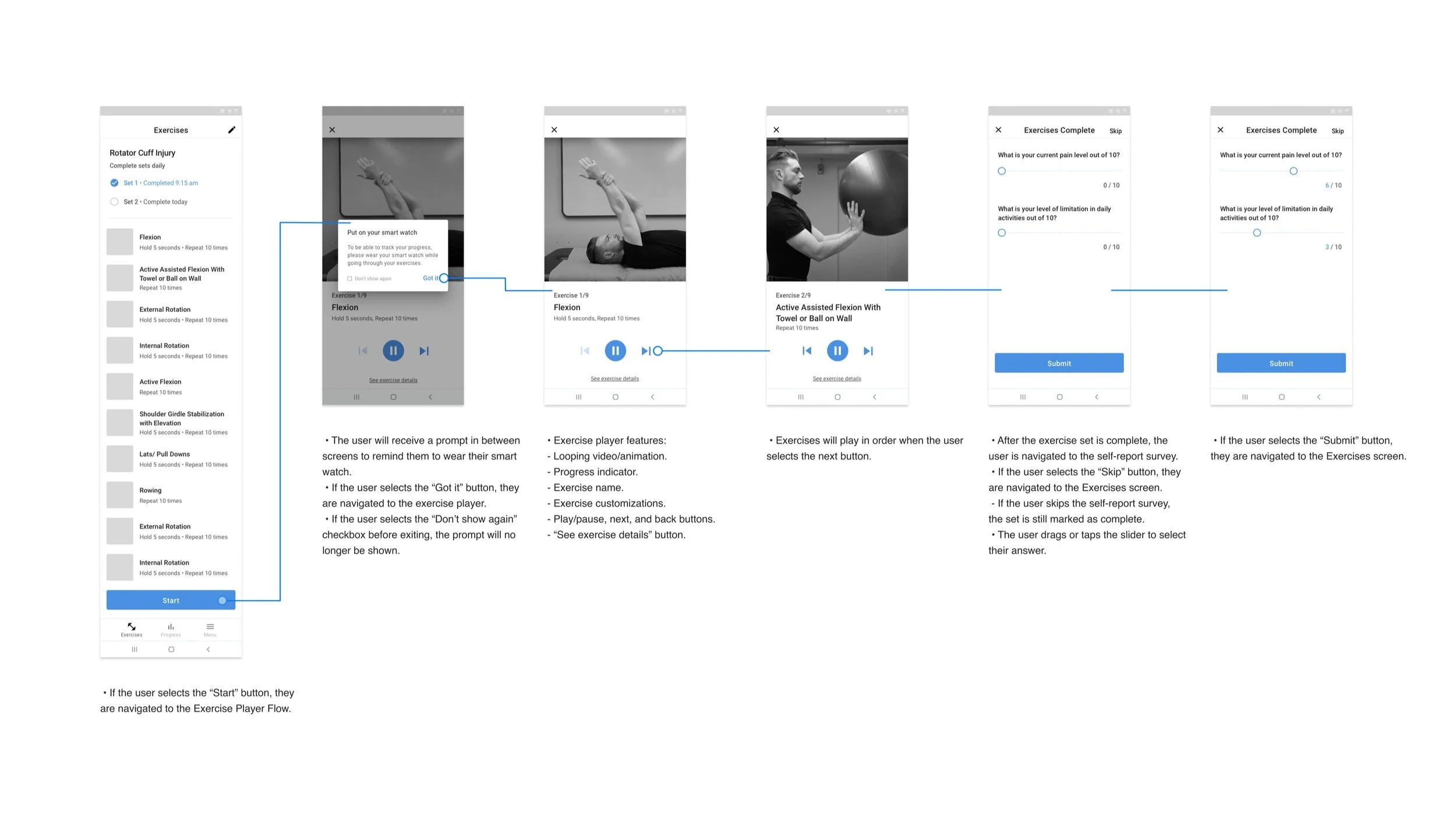
Wireframe exercise flow

Onboarding screen based on user testing feedback

Colour palette for Halterix

UI prototype exercise flow

We got the contract!
🎉
We got the contract! 🎉
The build process
Upon clients' decision to proceed with the build phase following the Blueprint, I expanded the designs to encompass all pages, states, and error scenarios. Injecting life into the product with thoughtful animations, I completed the rest of the ecosystem.
In my role as a Product Designer at a small agency, I also took charge of managing Agile ceremonies and ensured the project stayed on course and within budget. The build phase was divided into two distinct stages:
The Trial phase tailored for a clinical trial with Sunnybrook
The Commercial phase which marked the creation of an enhanced product for purchase by physiotherapy practices
-
Prior to commencing the build phase, we established the backlog and organized the necessary Agile ceremonies to effectively manage the project. Here is how I started the project:
Created Tickets from line items in the Blueprint estimates.
Sized tickets with the dev team.
Created a burndown chart to track progress.
Set up review cycles for iterative QA and alignment.
-
Given that the Blueprint did not encompass every screen, I expanded my designs to cover all remaining screens and completed the necessary flows.
Created empty states for non-content scenarios.
Ensured user-friendly error handling.
Completed the journey, allowing for different end states.
Addressing unhappy path user interactions.
-
I developed polished designs for both the smartwatch and web portal segments. These aspects of the project had a more minimalistic approach, with the watch app UI dedicated solely to exercise feedback, and the portal offering a straightforward way to manage patients and practitioners for the commercial product.
This phase adhered to the same review schedule as the Blueprint, with 2 internal and 2 client reviews per week until completion.
-
Ensuring smooth development, I prepared and maintained a library containing images, videos, and exercise descriptions. This resource facilitated streamlined communication and coordination throughout the development process.
-
As part of the Agile process, I conducted thorough reviews of each frontend ticket to guarantee the quality of the design implementation.
Ensured a consistent, visually appealing design.
Verified functionality for seamless user experiences.
-
I managed the setup of everything in the Play Store for both phase launches, overseeing tasks such as:
Prepared and launched app updates.
Created and optimized assets and descriptions.
Met app store requirements for submission.
Calibrated required permissions.

Removing an exercise from a patient file in the Practitioner tablet app

The user guide on the Patient app

Editing a Patient's information on the web portal

Waiting to connect state on the Patient watch app
What I could have done differently…
More emphasis on accessibility
Considering that many patients might be injured and potentially less tech-savvy, prioritizing accessibility and ease of understanding should have been a higher focus.
While this was on our radar, looking back, there were additional measures I could have taken, such as increasing the smallest font size, enhancing touch targets, and incorporating more auditory feedback options.
Provide extended onboarding
Smartwatches may not be intuitive for users unfamiliar with them, leading to potential confusion on how to pair the watch with the phone.
In retrospect, incorporating supplementary instructions and providing a guided onboarding process for each tab could have been particularly helpful to guide users through the pairing process and enhance overall usability.
Create a smoother flow for practitioners
Considering the busy and distracted nature of practitioners during and after appointments, the process of filling out diagnoses or assigning exercises could have been more streamlined and informative.
Reflecting on this, incorporating progress indicators and potentially utilizing a step-by-step wizard might have offered a more user-friendly solution, focusing practitioners' attention on small, manageable actions at a time.
The launches 🚀

Sunnybrook Clinical trial
In January 2020, Sunnybrook, Canada's second-largest hospital, initiated a study on adherence patterns involving 120 physical therapy patients with rotator cuff pathologies. Participants were equipped with a Wear OS smartwatch, and their adherence to home exercises was monitored using Halterix's cloud-based motion insight AI.
The early findings, subject to peer review, have been recently published in the JMIR Rehabilitation journal.

Halterix Commercial product
Serving as a demonstration of Halterix's motion insight technology, PT+ and PT+ Clinic stand as physical therapy apps crafted to enhance adherence, accelerate recovery times, and improve outcomes. PT+ seamlessly integrates with any off-the-shelf Wear OS smartwatch to monitor home exercise performance, generating reports to keep patients on track. The progress is securely shared with care providers through PT+ Clinic.
Released to selected Canadian physical therapy clinics in May 2021, PT+ and PT+ Clinic are currently in a closed beta phase.

The Results
Both launches proved successful, and based on the current Halterix website, it appears they are transitioning to position their API as the primary product.
This shift may be attributed to the user and technical constraints outlined earlier. Engaging in this project was a fulfilling experience, especially due to the intriguing user challenges, involvement in the medtech space, and the utilization of AI and ML technologies.
Here is the Commercial build figma prototype if you’d like to take a look.

